
Jan Elvis
15.10.2025

Jan Elvis
15.10.2025
If you want to get better at discipline, the first place to look isn't inward at your willpower—it's outward at your environment.
Real, sustainable discipline isn't about forcing yourself through sheer grit or punishing missteps. It's about making small, deliberate changes to your surroundings. Think decluttering your desk, silencing phone notifications, or laying out your gym clothes the night before. These simple acts remove the friction that stands between you and your goals.
So many of us have been taught to think of discipline as a fixed personality trait. You're either a "disciplined person" or you're not. That's just not true.
Discipline is a skill, and like any other skill, it needs a solid foundation to be built upon. And that foundation isn't raw willpower—it's your environment. Trying to stay focused in a chaotic, distracting space is like trying to swim upstream in a powerful river. You'll just end up exhausted and discouraged.
The secret is to stop muscling your way through and start designing your life so that the right choice is also the easiest one. This shifts the whole dynamic. Instead of a constant battle of wills, discipline becomes a thoughtful process of setting yourself up for success.
Your surroundings have a massive, and often underestimated, impact on your ability to stick with your intentions. We see this principle play out everywhere, from corporate offices to classrooms. For instance, a positive disciplinary climate is one of the most important factors for helping students focus.
Research shows that around 20% of students in OECD countries say they can’t work well because of classroom disruptions. Even more telling, about one in three admit to being distracted by their phones and other devices during class. It’s a perfect illustration of how a distracting environment directly sabotages focus.
Discipline is not about what you do, but what your environment allows you to do consistently. By removing distractions and adding positive cues, you make follow-through the path of least resistance.
This is not a new idea, but it's one we often forget. The infographic below breaks down how a few simple environmental tweaks can lead to huge gains in focus and consistency.
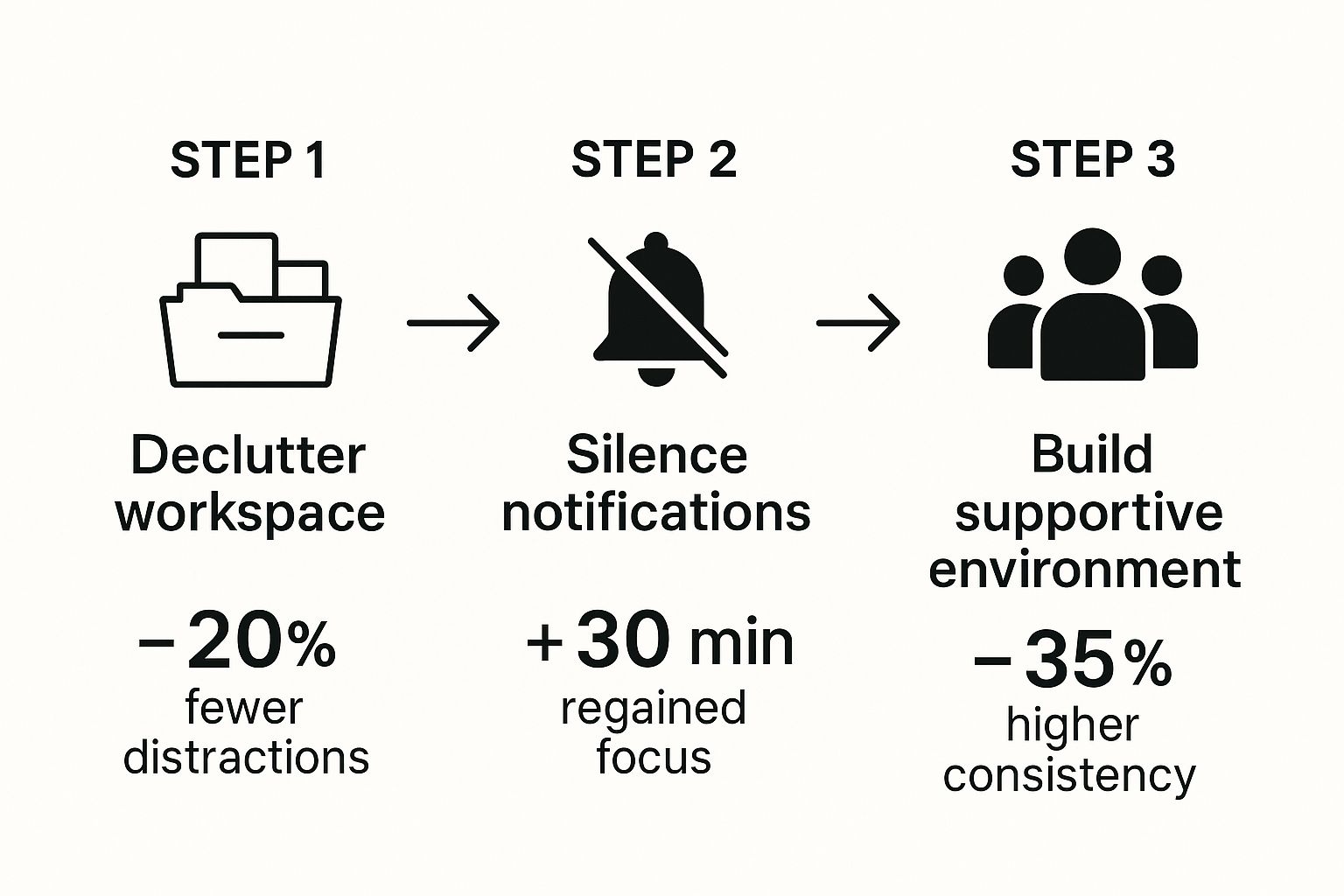
You can see the domino effect in action: a cleaner space leads to fewer distractions, which frees up your mental energy and ultimately makes consistent action feel almost automatic.
This whole approach represents a critical mindset shift—moving away from punishing ourselves for failure and toward empowering ourselves for success.
Understanding the core differences between outdated and effective approaches to discipline is key.
| Old Approach (Punishment-Focused) | Modern Approach (Empowerment-Focused) |
|---|---|
| Relies on brute-force willpower to overcome temptation. | Designs an environment where temptation is minimized. |
| Criticizes and feels guilty about slipping up. | Views setbacks as data to adjust the environment. |
| Focuses on what not to do (e.g., "don't eat junk food"). | Focuses on making the desired action easier (e.g., prepping healthy snacks). |
| Sees discipline as a constant, draining battle. | Sees discipline as the result of smart, upfront preparation. |
When you adopt an empowerment-focused mindset, the entire game changes.
So, instead of beating yourself up the next time you lose focus, try auditing your physical and digital spaces first. Ask yourself a simple question: "What's one small thing I can change right now to help my future self succeed?"
This simple reframe is the first step. To go deeper and really get a handle on this, check out this excellent guide on how to build lasting self-discipline.
Let's get one thing straight: willpower isn't some infinite well you can draw from. It’s more like a phone battery—it starts at 100% in the morning and drains with every decision you make, every temptation you resist.
So, instead of white-knuckling your way through the day, fighting off distractions, let's try a smarter approach. We're going to redesign your environment so that the disciplined choice becomes the easy choice. Designers call this choice architecture; I call it stacking the deck in your favor.
The idea is simple: create a frictionless path toward the things you want to do and add a ton of friction to the things you don't. Want to read more? Don't just "decide" to read more. Put a book on your pillow. Swap the TV remote's spot on the coffee table with the book. You’re no longer relying on a fleeting burst of motivation; you're using a physical cue to nudge yourself in the right direction.

Your environment is constantly talking to your brain, sending subtle (and not-so-subtle) cues about what you should do next. A cluttered desk screams "chaos," while a clean, organized space invites focus. To build discipline, you need to become the curator of these signals.
Start with where you spend most of your time. If you work from home, that dedicated workspace is non-negotiable. Even if it's just a corner of the kitchen table, claiming that spot tells your brain, "When I'm here, I work."
Here are a few quick wins to get you started:
By proactively managing your environment, you conserve precious mental energy. Instead of using willpower to say "no" to that cookie a dozen times, you use a tiny bit of energy once to put the whole box away.
This logic applies to any goal you have. Trying to eat healthier? Reorganize your fridge. Put the fresh veggies and fruit right at eye level and tuck the junk food into the bottom drawer. Make the healthy choice the most convenient one.
These days, our digital environment is just as powerful as our physical one. Maybe even more so. Those endless notifications, the cluttered home screen—they are engineered to hijack your attention and sabotage your discipline.
Think of your phone's home screen as prime real estate. Treat it that way.
When you take control of your physical and digital spaces, you stop leaving discipline to chance. You're building a supportive ecosystem where your goals aren't just possible—they become the path of least resistance. It's not about brute force; it's about smart, strategic design.
Trying to change everything about your life all at once is a surefire way to burn out and give up. The real secret to building discipline isn't about launching a dozen difficult new routines at the same time. It's much simpler: find and focus on one single keystone habit.
This one foundational routine acts like a trigger, creating a positive chain reaction that makes other good habits feel surprisingly easy to adopt.
Think of it like setting up a line of dominoes. The initial push on that first one is the only real effort required. Once it falls, it sets off a cascade, knocking down all the others without you having to touch them individually. This is exactly how you can turn the overwhelming idea of "becoming disciplined" into something manageable and momentum-driven.

Your keystone habit is deeply personal; what works for one person might not work for you. It isn't always the biggest or hardest habit. Instead, it’s the one that creates the most powerful ripple effects across your life. The best ones are small enough that they don't feel intimidating but significant enough to shift your mindset.
So, what does this look like in the real world? Here are a few classic examples and the dominoes they tend to knock over:
Lasting self-control is all about understanding how to build healthy habits that truly last. The trick is to pick something that aligns with the person you're trying to become.
Your keystone habit shouldn't feel like a chore. It should be a small, strategic win that makes you feel capable and in control, setting a positive tone for the rest of your day.
Once you’ve picked a potential keystone habit, the next step is crucial: make it ridiculously easy. So easy you can’t possibly say no.
If you want to start exercising, don't commit to a grueling hour at the gym. That’s a recipe for failure. Instead, just commit to putting on your workout clothes and doing five push-ups. The win isn't the workout itself; it's the simple act of showing up.
This microscopic approach completely lowers the barrier to entry. It helps you bypass the mental resistance that kills most new habits before they even get started. In the beginning, consistency is so much more important than intensity.
After a while, the habit will become automatic—just something you do. That's when you can gradually increase the duration or difficulty. This method builds discipline from the ground up, fueled by a series of small, consistent wins instead of a limited supply of willpower.
Let's be honest, discipline rarely fails because we're not motivated. It usually crumbles under the weight of a vague, fuzzy goal. An ambition like "get in shape" or "be more productive" sounds great in your head, but it gives you absolutely nothing to grab onto when it's time to actually do something. It’s a perfect recipe for procrastination.
The fix isn't about mustering more willpower. It's about getting brutally specific and creating clear instructions for your future self. Think of it as removing all the guesswork so your desired action becomes the path of least resistance.
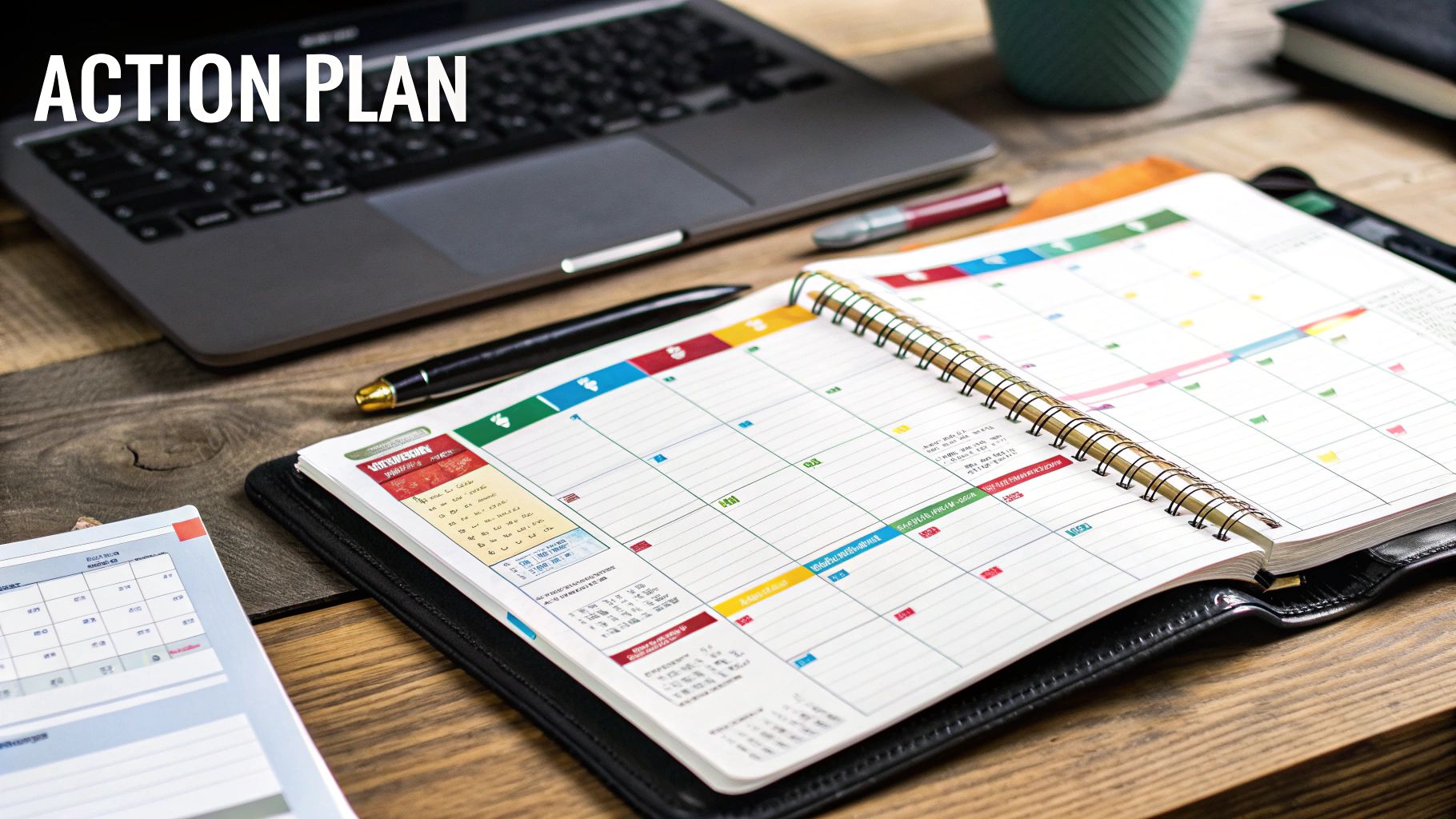
One of the most powerful psychological tools for this is called implementation intentions. It sounds academic, but it's just a simple "if-then" plan that you decide on ahead of time. You’re telling your brain exactly when, where, and how you’re going to act.
It turns a wishy-washy goal into a concrete script.
See the difference? When 5:30 PM on Monday hits, the internal debate is over. You don't ask yourself if you feel like going. The decision was already made. You just execute the plan.
By pre-loading the cues and routines for your goals, you're essentially programming your behavior. This bypasses decision fatigue and makes following through almost automatic. The hard choice becomes a simple reflex.
Big goals are discipline killers. Staring down a huge project like "build a website" is so intimidating that it's easier to just scroll through social media instead. The trick is to break that mountain down into a series of tiny, non-threatening hills.
Instead of one massive task, you create a checklist of small, doable steps.
Each one of these is a quick win. You can knock one out in 15-30 minutes, which builds momentum and makes you feel accomplished. Suddenly, the overwhelming project feels completely manageable.
Getting a handle on this kind of micro-planning is a cornerstone of solid time management. For a deeper dive into structuring your day, you can learn more about how to manage time effectively and make sure these well-laid plans actually have room to breathe.
https://www.youtube.com/embed/STdBTYIdn-g
Let's be real: you're going to have an off day. It's inevitable. You'll skip a workout, grab takeout when you planned to cook, or lose an hour to mindless scrolling. The true measure of your discipline isn't about achieving a perfect track record—it’s about how you recover when you stumble.
The most common trap I see people fall into is the "all-or-nothing" mindset. You miss one gym session and immediately think, "Well, this week's a wash. I'll just start over on Monday." This thinking is the arch-nemesis of long-term consistency. One small slip-up doesn't need to turn into a full-blown avalanche.
Discipline is really about the art of the course correction, not flawless execution. It's about getting back on track quickly, without beating yourself up.
Instead of getting frustrated with yourself, get curious. Every setback is a piece of data. It’s your chance to figure out what went wrong and tweak your game plan. Self-punishment is totally counterproductive; it just creates a toxic cycle of guilt and avoidance that makes you want to quit altogether.
This isn’t just feel-good advice; there's research to back it up. Punitive, harsh approaches to discipline are often damaging. One study, for example, found that this style of discipline was linked to a 64% higher likelihood of depressive symptoms in students. On the flip side, a supportive and understanding approach actually boosts well-being and improves discipline. You can dive deeper into the full findings on youth mental health and discipline if you're interested.
Instead of letting a misstep pile on the stress, use it as a moment to problem-solve. When you understand what causes stress and how to handle it, you become more resilient. We have a whole guide on how to reduce stress naturally with some great strategies.
The goal is resilience, not perfection. A disciplined person isn't someone who never messes up. They're someone who gets back up one more time than they fall down.
When you have a setback, don't waste time stewing in it. The key is to immediately shift from feeling guilty to taking action. Here's a simple, two-step process I use.
This simple shift turns you from your own worst critic into a clever strategist. You replace self-blame with a proactive mindset, which ensures that one off day is exactly that—just one day, not the end of your journey.
We’ve all heard it before: to get more disciplined, you just have to be tougher on yourself. Push harder, ignore the exhaustion, and use a little harsh self-talk to whip yourself into shape. But if you’ve ever tried this "tough love" approach, you probably know it almost always falls flat in the long run.
Think of it this way: using fear, shame, and guilt to motivate yourself is like trying to run a car on sludge. Sure, it might chug along for a few miles, but eventually, the engine will seize up. This approach completely burns out your intrinsic motivation—that natural, internal drive to do something for its own sake—and leaves you with nothing but dread.
Relying on punishment to build discipline is fundamentally broken. It’s just not sustainable.
Look at the research on this from a broader perspective. The World Health Organization estimates that a staggering 1.2 billion children face corporal punishment every year. Study after study confirms this approach leads to a host of negative outcomes. It's why so many global agencies now push for non-violent alternatives, and that same logic applies to how we treat ourselves. You can read more about the effects of punitive actions from WHO.
This self-punishing mindset also has a nasty habit of creating avoidance. When you constantly link a task with negative emotions, your brain’s natural instinct is to run the other way. Procrastination suddenly becomes your best friend. This can even spiral into anxiety, making it feel impossible to tackle challenges head-on. If this sounds familiar, our guide on how to overcome social anxiety has some great strategies for working through those feelings.
True discipline isn’t about forcing yourself to do things you hate. It’s about building a system where doing the right thing feels like the easiest, most natural choice—all powered by self-compassion, not self-criticism.
At the end of the day, a more humane and understanding approach to discipline is what actually works. It builds real, lasting resilience and turns self-improvement into a lifelong journey you can actually enjoy, not just a miserable week-long sprint.
When you first start working on your personal discipline, a lot of questions pop up. It's easy to grasp the concepts, but when you're tired, overwhelmed, or just plain stuck, applying them is a whole different ball game. Let’s walk through some of the most common hurdles I see people face.
This is probably the number one question I get. Everyone wants to know when they'll "arrive." The honest answer? There's no magic finish line.
You might have heard stats that a new habit takes anywhere from 18 to 254 days to stick. But focusing on the number of days misses the point entirely. The real goal isn't hitting a specific date on the calendar; it's about mastering the art of consistency. Forget the timeline and focus on just showing up today. That daily, gradual progress is what builds a discipline that actually lasts.
We’ve all been there. You know what you should do, but you just don't feel like it. This is where the real work happens. Motivation is a feeling, and feelings are fickle. Discipline, on the other hand, is a system.
Relying on motivation to build discipline is like waiting for a perfect sunny day to start planting a garden. True growth comes from watering it every day, rain or shine.
When your motivation well runs dry, you have to lean on the structures you’ve already built. This is where your pre-planned schedule, your optimized environment, and your simple routines save the day.
A simple trick for these moments is the "two-minute rule." Tell yourself you only have to do the thing—whether it's writing, exercising, or cleaning—for just two minutes. The biggest hurdle is almost always just getting started. Once you’re in motion, inertia often takes over and you'll find it's much easier to keep going.
Absolutely, 100% yes. This is a big one, because so many of us tie procrastination to our identity. We think, "I'm just a procrastinator." But procrastination isn't a personality trait; it's a learned habit, often rooted in deeper things like a fear of failure or feeling completely overwhelmed.
You undo this habit not by willpower alone, but by strategy. Break those intimidating projects into ridiculously small, non-threatening steps. Each tiny step you complete builds a little bit of momentum and provides your brain with proof that you can follow through. It’s a skill, and like any skill, it gets stronger every time you practice.
At Main Character, we believe that building discipline is the foundation of confidence. Our personal care products are designed to be part of a daily routine that helps you look, feel, and perform your best. Start building your routine today at https://www.dontlooktrash.com.

05.12.2025
How to Stay Focused at Work 7 Actionable Tips
04.12.2025
A Guide to Shaving with Sensitive Skin
03.12.2025
Best Grooming Products for Men A Definitive Guide
02.12.2025
How to Build Confidence for Men: Practical Guide
01.12.2025
Face Lotion With SPF Your Guide to Daily Skin Protection
30.11.2025
Natural Skin Care Products Men Can Trust
29.11.2025
How to Maintain Healthy Skin A No-Nonsense Men's Guide
28.11.2025
what causes dark circles under eyes: tips and fixes