
Jan Elvis
05.12.2025

Jan Elvis
05.12.2025
Staying focused isn't about brute force or sheer willpower. It’s about building smart, intentional systems that set you up for success. The real secret is to prime your brain for concentration before you even start, manage your energy with planned breaks, and ruthlessly cut out distractions.
The battle for your attention is often won or lost in the first hour of the day. How you spend those initial moments sets the stage for your concentration, your productivity, and your ability to fend off distractions later on. A deliberate, screen-free routine can be the difference between a day of scattered, shallow work and one of deep, meaningful progress.
Think about it: what’s the first thing you do when you wake up? If it’s grabbing your phone, you’re immediately letting a flood of emails, notifications, and social media drama hijack your mental state. A simple shift to a non-digital activity stops your brain from flipping into that reactive, chaotic mode right from the get-go.
Your brain's ability to focus is at its absolute peak in the morning. When you immediately dive into your inbox or scroll through social feeds, you’re squandering that precious mental energy on low-value tasks and other people's agendas. You're basically draining your concentration reserves before the real work has even begun.
The point of a morning routine isn't to cram more stuff into your day. It’s to build a protective buffer that lets your mind wake up calmly, setting a deliberate and focused tone before the workday chaos inevitably kicks in.
This proactive approach is more critical than ever. Employee engagement directly impacts focus, yet as of 2024, only about 21% of workers worldwide reported feeling actively engaged at their jobs. That widespread disengagement leads to staggering losses in productivity, making it essential to take control of your own focus.
What you eat for breakfast has a direct line to your cognitive performance. A sugary cereal or a pastry might feel good for a moment, but it sends your blood sugar on a roller coaster. You get a quick spike, followed by a guaranteed crash that leaves you feeling sluggish and foggy by 10 AM.
To keep your energy levels steady, you need a meal built around protein, healthy fats, and complex carbs.
Combine a solid breakfast with a short, non-work activity—a quick 10-minute walk outside or reading a chapter from an actual, physical book does wonders for clearing out the mental cobwebs. For anyone looking to build a more structured start, this guide to creating a morning routine for men has some fantastic, practical ideas you can easily adapt. These small habits might not feel like much at first, but they compound over time to create a powerful foundation for a truly productive day.
Feeling swamped? That’s the quickest way to kill your focus. When your to-do list looks more like a novel, your brain just short-circuits. You start bouncing between tasks, doing a little bit of everything but accomplishing nothing. The answer isn't to grind harder; it's to get smarter by deciding what actually matters before you dive in.
Getting your priorities straight turns a messy workload into a clear, manageable game plan. You stop reacting to whatever's yelling the loudest and start directing your energy where it counts. This is a game-changer for staying focused, as it cuts down on decision fatigue and paves the way for deep, uninterrupted work.
One of the best tools I've found for slicing through the chaos is the Eisenhower Matrix. It’s a dead-simple framework that sorts your tasks into four boxes based on two things: urgency and importance. It forces you to be honest about what needs your attention now versus what’s just noise.
Here’s how it breaks down your to-do list:
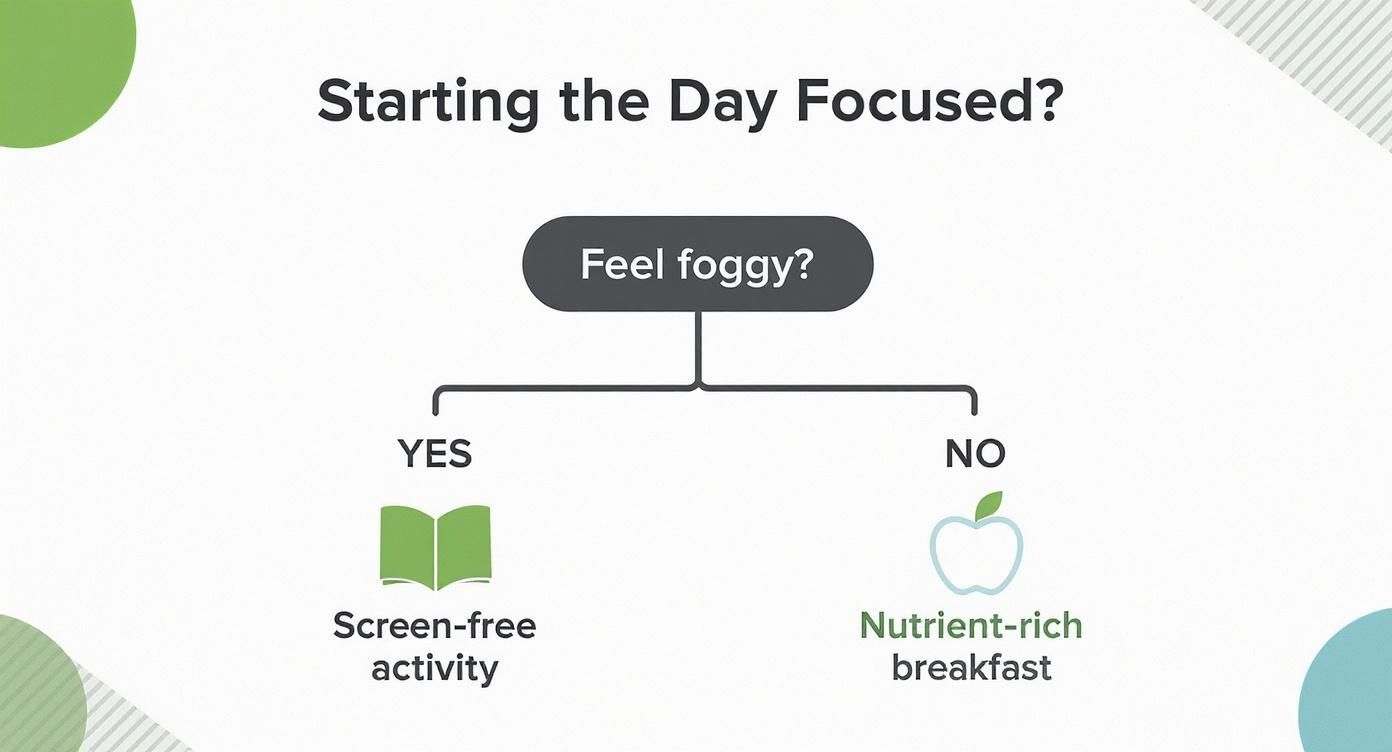
This simple decision tree nails a key point: before you even think about your tasks, you have to get your own head straight. A quick walk or a solid breakfast can do more for your focus than any productivity app.
If the matrix feels a bit too rigid, try this: identify your Most Important Tasks (MITs). Instead of staring at a massive list, you just pick 1 to 3 things that absolutely must get done today. These are the big wins—the tasks that, if completed, will make the day a success.
For instance, if you're a marketer, your MITs might be "Launch the new ad campaign" and "Finalize the Q3 analytics report." Everything else, from answering Slack messages to tweaking old spreadsheets, is secondary.
This approach is all about ruthless prioritization. You’re not trying to do more; you’re trying to do what matters.
Not sure which framework fits you best? Both are powerful, but they cater to different work styles and demands. This table breaks down the key differences to help you decide.
| Feature | Eisenhower Matrix | Most Important Tasks (MITs) |
|---|---|---|
| Best For | Complex roles with varied, unpredictable demands (e.g., managers, support leads). | Goal-oriented roles with clear, project-based work (e.g., developers, writers). |
| Core Principle | Categorizing all tasks based on urgency and importance to decide what to do, delegate, or delete. | Selecting a few high-impact tasks to guarantee progress on major goals. |
| Daily Workflow | A continuous sorting process that helps you manage incoming requests and shifting priorities. | A focused sprint on 1-3 key deliverables, pushing everything else to the side. |
| Primary Benefit | Reduces overwhelm by providing a clear system for handling a high volume of tasks. | Creates strong daily momentum and a clear sense of accomplishment. |
| Potential Downside | Can feel overly analytical; the "Important, Not Urgent" quadrant is easy to neglect. | Non-MIT tasks can pile up if not managed, potentially causing issues down the line. |
Ultimately, the best method is the one you'll actually use. The Eisenhower Matrix is fantastic for taming chaos, while MITs are perfect for driving focused, goal-oriented progress.
To make this stick, try this little trick: end your workday by picking your MITs for tomorrow. It only takes five minutes, but it lets you sign off with a clear head, knowing exactly where to start when you walk in the next morning. No hesitation, just pure, focused action. Once you've nailed down what to work on, you can explore other strategies to increase your overall productivity at work to make sure every minute counts.
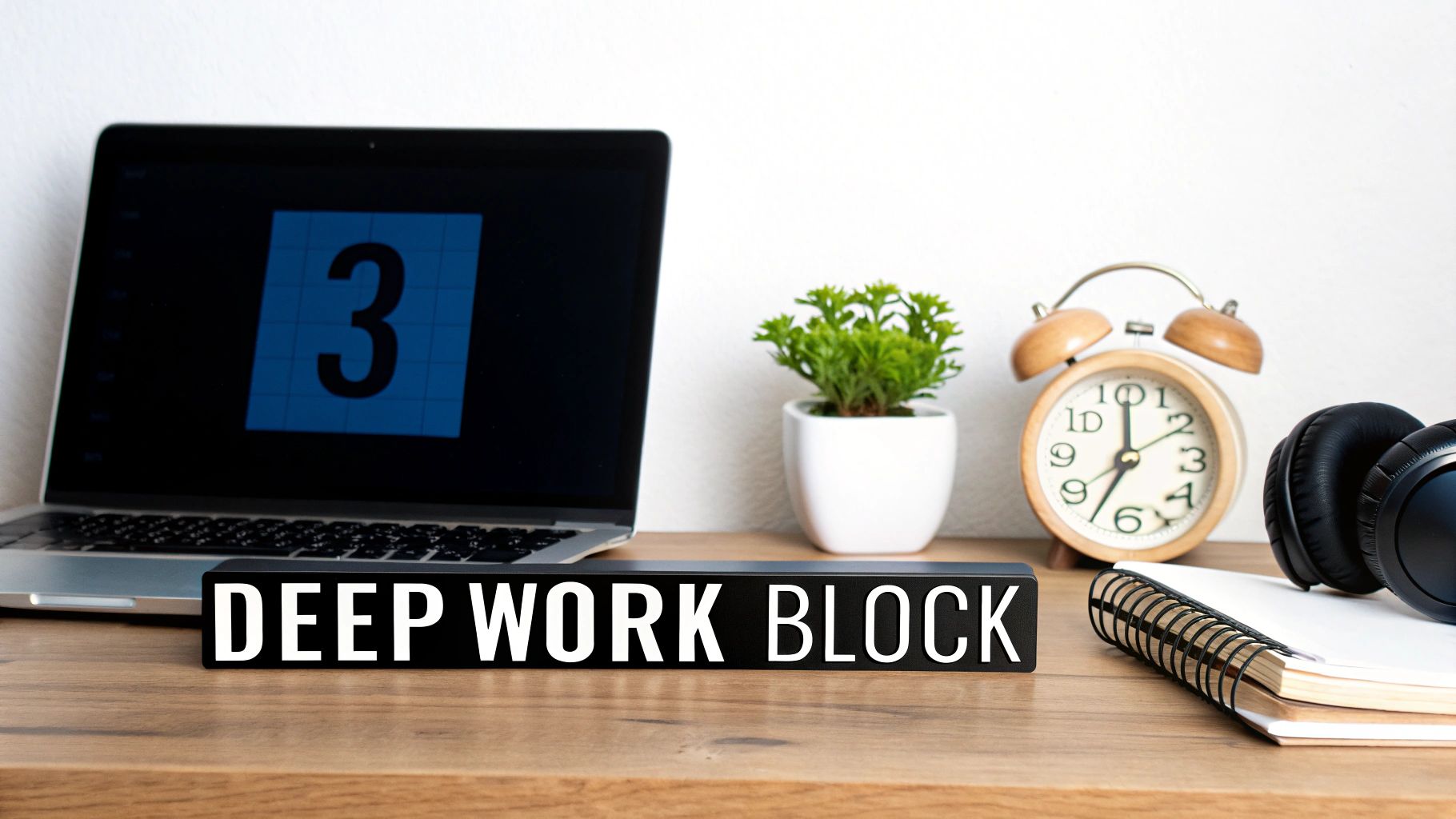
Here's a hard truth: lasting focus isn't about brute-forcing your way through the day with sheer willpower. It’s really about building a structure that fiercely protects your attention. A vague, sprawling to-do list is basically an open invitation for every distraction to come knocking.
By giving your day a clear framework, you’re creating dedicated, sacred pockets of time for deep, uninterrupted work. It's about making it easier to stay on track when it really matters.
Two methods have stood the test of time for their raw effectiveness: the Pomodoro Technique and Time-Blocking. They both work by turning your good intentions into a concrete plan, slamming the door on procrastination before it can even get a foot in.
The Pomodoro Technique is almost laughably simple, and that’s why it works. You work in focused 25-minute sprints, then you must take a 5-minute break. This little cycle isn't just about managing the clock; it's about managing your mental energy.
Those short bursts of work feel completely doable, which is perfect for tricking your brain into starting a task you’ve been dreading.
The real secret sauce, though? The breaks. That five-minute pause is non-negotiable. It gives your brain a chance to reset and recharge, which helps you sidestep the mental fatigue that leads to burnout and mindless scrolling. During your break, actually get up. Stretch, grab a glass of water, or just stare out a window—do anything but check your phone or email.
A small but powerful hack I swear by is using a physical kitchen timer instead of your phone. It creates a real, tangible commitment to the session and completely removes the temptation to check notifications the second the alarm goes off.
After you complete four of these "pomodoros," you reward yourself with a longer break, maybe 15-30 minutes. This rhythm of intense work and deliberate rest is incredibly powerful for maintaining high-quality concentration all day. Mastering this is a foundational skill, and if you want to go deeper, exploring how to manage time effectively can really lock in the habit.
While Pomodoro is brilliant for managing your work sprints, Time-Blocking is what gives your entire day a map. This is where you assign a specific time slot on your calendar to every single thing you need to do—from deep work on a critical project right down to checking emails.
Suddenly, your to-do list becomes an actual schedule. "I need to work on the report" transforms into "10:00 AM - 11:30 AM: Work on Q3 Report."
This simple shift takes away the constant, draining mental gymnastics of figuring out what to do next. Your calendar becomes a visual roadmap, cutting down on decision fatigue and giving you real clarity.
Here are a few tips to make it stick:
If your mind tends to wander and you need a more structured approach, check out this a practical guide to time blocking for some really actionable tips. When you combine these strategies, you create a powerful defense against distraction, enabling you to get higher-quality work done in way less time.
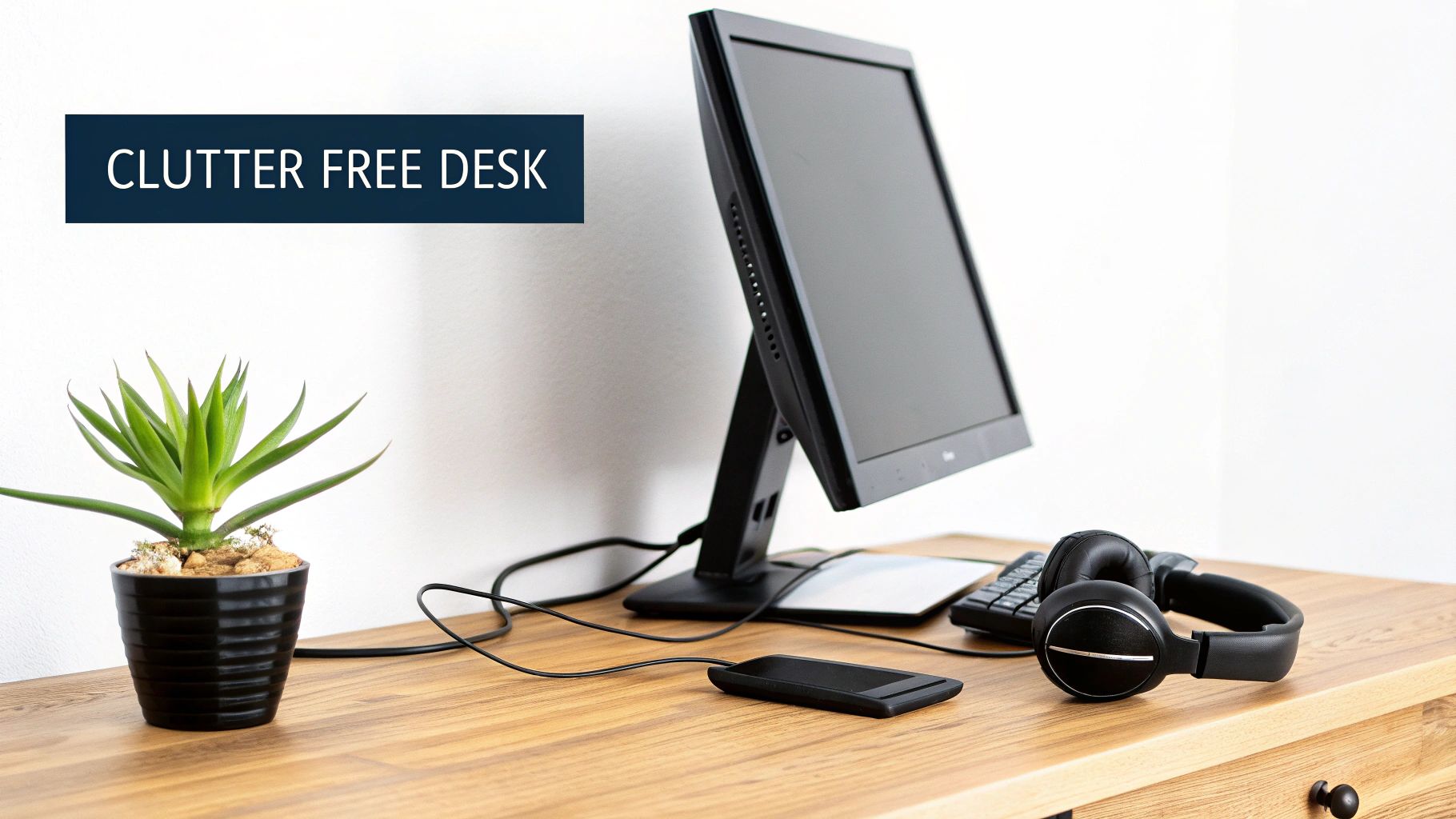
Ever notice how hard it is to think straight when your desk is a chaotic mess? Your ability to focus is directly tied to your environment. When your space—both physical and digital—is cluttered, your brain has to work overtime just to filter out the noise. That leaves precious little mental energy for the work that actually matters.
The idea here is to intentionally design a workspace that supports deep concentration, rather than one you have to constantly fight against.
This isn’t just about aesthetics; it has a real impact on your output. The shift to remote work has proven just how powerful a tailored, interruption-free environment can be. Remote workers have seen a productivity bump of around 9% compared to their in-office counterparts, adding about 29 extra minutes of productive time to their day. Considering it can take a staggering 23 minutes to get back on track after just one interruption, reclaiming that time is a game-changer. You can find more details on these productivity findings on ProofHub.
Let’s start with your desk. You don’t need a Pinterest-worthy setup, but you do need a space that's free of visual clutter. A desk piled high with old coffee mugs, random papers, and tangled cords is constantly sending signals to your brain that there are other things to do.
The goal is to make the right things easy and the wrong things hard. When the only thing on your desk is your current task, focus becomes the path of least resistance.
Try this: a simple end-of-day reset. Before you sign off, take two minutes to clear your desk. Put papers away, wipe down the surface, and set out what you need for tomorrow morning. It’s a tiny habit that makes a massive difference in how your next day begins.
And don't forget basic ergonomics. If you're constantly shifting in your chair or rubbing a sore neck, your focus is already split. Make sure your chair supports your back, your monitor is at eye level, and your keyboard is positioned comfortably. Eliminating physical discomfort frees up a surprising amount of mental bandwidth.
Your digital environment is just as crucial. A desktop crammed with random files and a browser choking on 30 open tabs is the digital version of a messy room. It creates mental friction every single time you look at your screen.
It's time to practice good digital hygiene. Here are a few simple moves that can help you reclaim your focus:
By decluttering both your physical and digital worlds, you’re doing more than just tidying up. You're building a fortress for your attention, making it far easier to stay locked in on what matters.
Even with the best-laid plans, a perfect morning routine, and a prioritized to-do list, focus can evaporate in an instant. That’s just life. The dreaded afternoon slump rolls in, a colleague appears with an "urgent" request, and suddenly your brain feels like mush.
Learning how to navigate these focus killers is what separates a productive day from a frustrating one. The trick isn't to fight these moments with willpower—that's a battle you'll almost always lose—but to have a toolkit of practical strategies to get back on track.
That heavy, foggy feeling that hits around 2 PM isn't just in your head. It’s a real biological dip tied to our circadian rhythms. While reaching for another cup of coffee is tempting, it’s often just a band-aid that can lead to a bigger crash later on.
A better approach is to reinvigorate your mind and body in a more sustainable way. The goal here is to create real energy, not just borrow it.
These small actions are surprisingly powerful. They reset your focus without the jitters and inevitable crash that comes with too much caffeine.
The most effective breaks are the ones that create a true mental and physical disconnect from your work. Stepping away from all screens—even for just five minutes—is crucial for allowing your brain to properly recharge and come back sharper.
Nothing shatters a deep work session like an unplanned interruption. A quick "got a minute?" from a coworker can completely break your concentration, and studies have shown it can take over 20 minutes to get back into that state of deep focus.
Protecting your time isn't about being rude; it's about setting polite but firm boundaries.
For instance, when a team member drops by, try saying something like, "I'm deep in the middle of something right now, but how about I swing by your desk in 30 minutes?" This acknowledges their request while protecting the valuable block of time you've already committed to.
Learning to manage these daily stressors is a huge part of maintaining mental clarity. If you're looking for more ways to build that resilience, finding techniques to reduce stress naturally can create a powerful foundation for a more focused mind. Having a few go-to phrases ready makes it so much easier to handle interruptions without derailing your day or damaging your work relationships.
Even with the best-laid plans, things come up. A solid routine is your foundation, but knowing how to handle those inevitable focus-killers is what keeps your day from derailing. Let's tackle some of the most common questions people have when trying to stay locked in at work.
Think of this as your troubleshooting guide for noisy offices, the constant ping of notifications, and that dreaded afternoon energy crash.
The open-plan office can feel like a nightmare for deep work. While you can't just tell everyone to be quiet, you absolutely can carve out your own bubble of concentration.
First things first: get a good pair of noise-canceling headphones. This is the single biggest game-changer. They don't just block out chatter; they send a clear visual signal to everyone around you: "I'm in the zone, please don't interrupt."
Sometimes, pure silence is just as distracting as noise. Try using ambient sound apps or websites. Playing some white noise, the low hum of a coffee shop, or even just instrumental music can mask the unpredictable sounds of an office and help you focus.
It also helps to be upfront with your team. A quick Slack message like, "Hey team, I'm going deep on the project report from 10 AM to noon, so I'll be slow to respond," works wonders. It manages expectations and protects your time. If your office has quiet zones or small phone booths, don't hesitate to book one for an hour or two when you really need to get something done.
The trick here is to stop being so reactive. If you let every notification pull you away from your work, you'll never get anything meaningful done. You have to be the one in control of your digital tools, not the other way around.
Instead of checking email and Slack whenever a notification pops up, schedule it. Try setting aside a 15-minute block at 11 AM and another at 3 PM to clear your inbox and messages. Outside of those windows? Turn off all notifications.
Seriously, find the "Do Not Disturb" or "Focus" mode on your computer and phone and use it aggressively. This one habit is a lifesaver. It stops the constant context-switching that absolutely shreds your ability to concentrate.
You can also get smarter with your email by setting up filters. Automatically sort newsletters, non-urgent updates, and CC'd messages into separate folders. This keeps your primary inbox clean and reserved for things that actually need your immediate attention.
Ah, the afternoon slump. It's a real biological thing, tied to our natural circadian rhythms, but you don't have to be a victim to it. And no, the answer isn't just to chug more coffee.
Take a hard look at your lunch. A big meal loaded with carbs and sugar is a one-way ticket to an energy crash an hour later. Instead, go for a balanced meal with plenty of protein and vegetables. This will give you steady, sustained energy. And drink water! Mild dehydration often feels just like fatigue.
Next, get moving. Around 2 PM, when you feel the fog rolling in, force yourself to take a brisk 10-15 minute walk. If you can get outside in the fresh air, even better. The movement and change of scenery can completely reset your brain.
Finally, work with your energy levels, not against them. Schedule your most difficult, brain-intensive tasks for the morning when you're sharp. Save the more routine, administrative stuff for the afternoon when your focus is naturally a little lower.
At Main Character, we believe that building routines for self-care is the foundation of discipline and confidence. Starting your day feeling your best sets the tone for focus and success. Explore our collection of premium grooming products to build a morning ritual that empowers you. Find your new routine at dontlooktrash.com.

04.12.2025
A Guide to Shaving with Sensitive Skin
03.12.2025
Best Grooming Products for Men A Definitive Guide
02.12.2025
How to Build Confidence for Men: Practical Guide
01.12.2025
Face Lotion With SPF Your Guide to Daily Skin Protection
30.11.2025
Natural Skin Care Products Men Can Trust
29.11.2025
How to Maintain Healthy Skin A No-Nonsense Men's Guide
28.11.2025
what causes dark circles under eyes: tips and fixes