
Jan Elvis
01.12.2025

Jan Elvis
01.12.2025
Let's be honest, a face lotion with SPF is your daily grooming MVP. It’s a moisturizer and a sunscreen rolled into one, designed to keep your skin hydrated while defending it against the sun's damaging rays. Think of it as the most efficient, non-negotiable step you can take for your skin.
Treating your daily SPF like a seatbelt is the best analogy I can think of. You don't just buckle up for long trips or when the weather's bad, right? You do it every time you get in the car for basic, essential safety. Your skin deserves that same commitment.
Sunscreen isn't just for the beach or a mid-summer cookout. The reality is, your skin is under attack from UV radiation every day, even when you'd never suspect it. That "incidental" sun exposure—the kind you get driving to work, sitting by a window, or walking the dog on an overcast day—really adds up.
Even on the cloudiest days, up to 80% of the sun's UV rays can cut right through and hit your skin. Over months and years, that silent damage accumulates, and the results eventually show up in the mirror.
Making a moisturizer with sun protection a daily habit is one of those simple moves with massive long-term benefits. This isn't about vanity; it's about the fundamental health of your skin.
Here's what that one step actually does for you:
A daily face lotion with SPF is the single most powerful anti-aging and health-promoting thing you can do for your skin. It's a few seconds in the morning for a lifetime of payoff.
Ultimately, this one product acts as your skin's daily armor. It defends against that slow, invisible damage that happens all year long, making sure your skin stays healthy, tough, and looking its best for the long haul. Making it a non-negotiable part of your morning is just a smart, disciplined move.
Walking down the skincare aisle can feel like trying to crack a secret code. You're hit with numbers, acronyms, and claims that make picking the right face lotion with SPF a real headache. But it's simpler than it looks. Once you know what a few key terms mean, you can grab any bottle and know exactly what you're getting.
The first thing you'll notice is the SPF, or Sun Protection Factor. Think of it as a rating for how well the product guards your skin against sunburn. The number is basically a time multiplier. If your skin normally starts to redden in 10 minutes, a lotion with SPF 30 theoretically buys you 30 times that long—about 300 minutes—before you burn.
Of course, that's in a perfect lab setting. In the real world, things like sweat and how much you apply will change the equation. It's also important to remember that the protection doesn't jump dramatically with higher numbers.
The sun sends out a couple of different types of ultraviolet (UV) rays that are bad news for our skin. A good sunscreen has to tackle both.
Since both types of rays cause damage, you absolutely need protection from both. That’s where the term "Broad-Spectrum" comes into play. If you see this on a label, you're golden. It's a guarantee that the product has been tested and proven to shield you from the full range of UVA and UVB radiation.
A high SPF number is only half the battle. Without Broad-Spectrum protection, you're leaving your skin vulnerable to the silent, long-term damage caused by UVA rays.
This is a daily fight, not just a beach day thing. Your skin is constantly up against threats that accelerate aging and increase health risks.
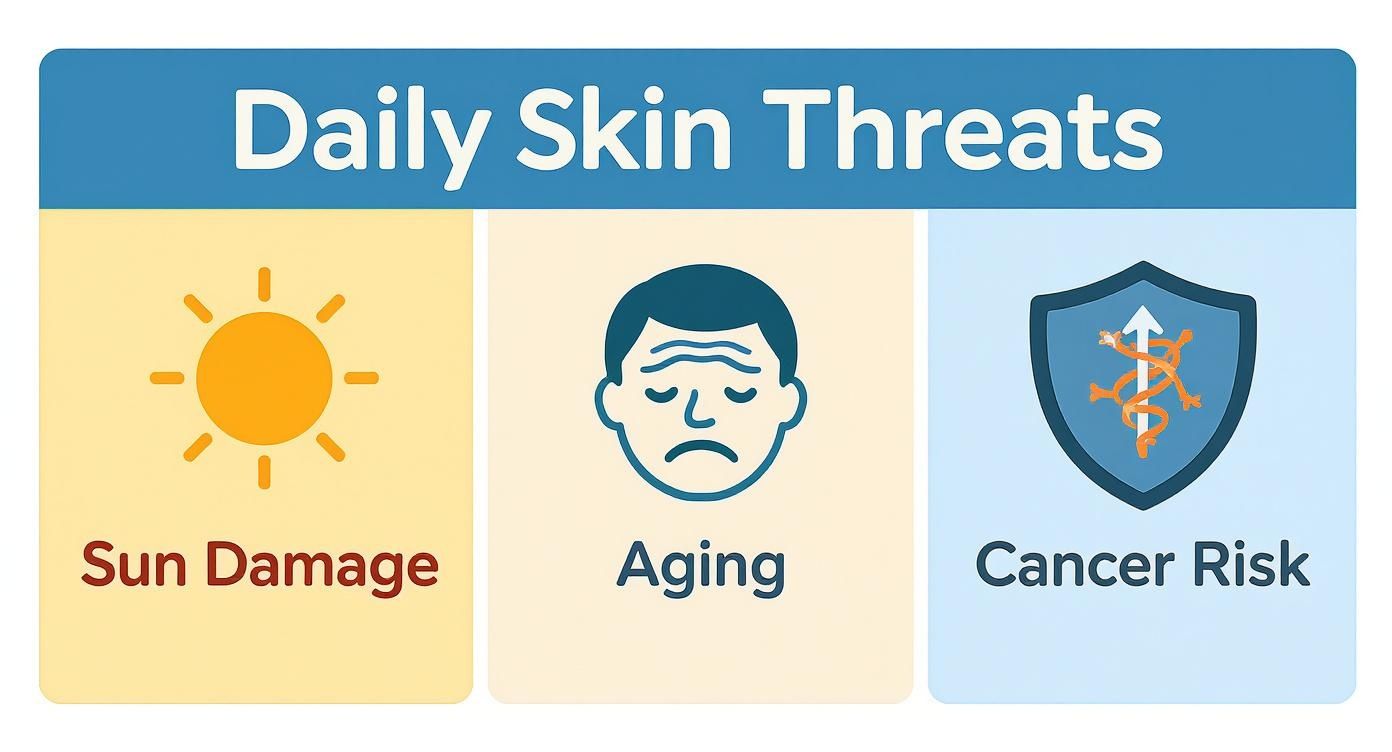
As the graphic shows, sun damage isn't just one thing—it's a direct line to looking older than you are and, more seriously, to skin cancer. It really drives home the need for a solid, broad-spectrum defense every single day.
Okay, so "Broad-Spectrum" is non-negotiable. But the SPF number still counts. The trick is to find the sweet spot for daily protection without getting lulled into a false sense of security by a super-high number. It's clear people are getting the message; the global sun care market is expected to reach USD 18.3 billion by 2032. You can read the full research on the sun care cosmetics market to see just how big this is getting.
So, what do those numbers on the bottle actually mean for blocking rays? Here’s a quick reference guide to put it all in perspective.
| SPF Level | Percentage of UVB Rays Blocked | Best For |
|---|---|---|
| SPF 15 | Blocks 93% of UVB rays | Quick trips outside, very low sun intensity. |
| SPF 30 | Blocks 97% of UVB rays | The daily standard recommended by dermatologists. |
| SPF 50 | Blocks 98% of UVB rays | Long days outdoors, beach trips, intense sun. |
| SPF 100 | Blocks 99% of UVB rays | Extreme protection for sensitive skin or post-procedure. |
Look at those percentages again. The jump from SPF 30 to SPF 50 is only a 1% increase in protection. While that can make a difference if you're outdoors all day, it shows that SPF 30 is already doing some serious heavy lifting.
No sunscreen blocks 100% of UV rays. That's why for everyday use—commuting, working near a window, running errands—a face lotion with SPF 30 is the gold standard. It gives you robust, reliable protection without going overboard.
When you grab a face lotion with SPF, the active ingredients doing all the hard work will be either chemical or physical. Knowing the difference is a game-changer for finding a product that works for you and feels good on your skin. They both protect you from the sun, but they take completely different approaches to get the job done.
Think of a chemical sunscreen as a sponge. The ingredients—stuff like avobenzone or octisalate—actually absorb into your skin. When UV radiation hits, these ingredients soak it up, convert it into a tiny amount of heat through a chemical reaction, and then release that heat before it can cause any damage.
A physical sunscreen, on the other hand, works more like a shield. You'll often hear these called mineral sunscreens because they use fine minerals like zinc oxide and titanium dioxide. These ingredients don't absorb; they sit right on top of your skin and create a physical barrier that literally deflects and scatters UV rays away from you, kind of like a mirror.
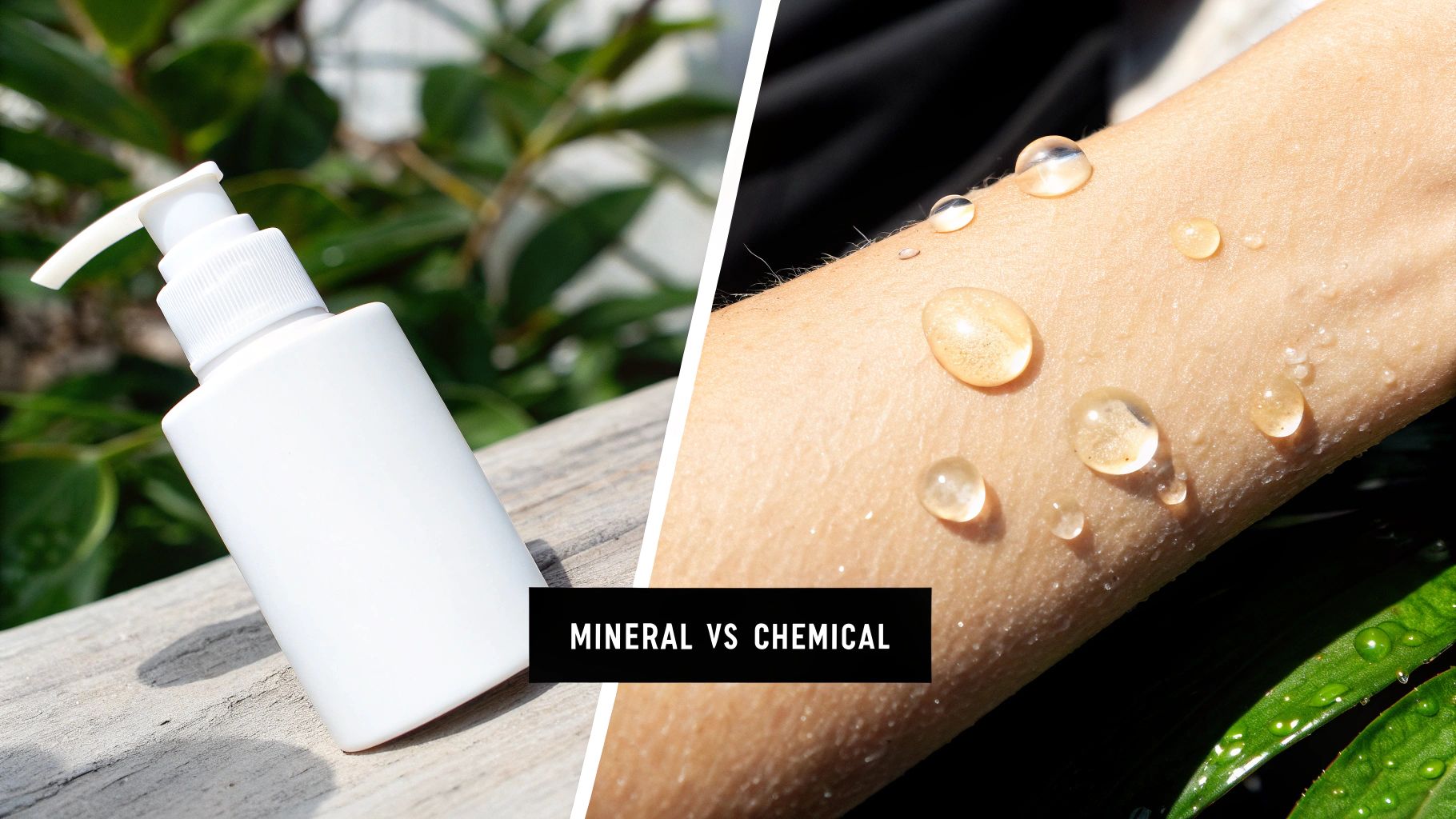
There's a reason chemical sunscreens are so common in daily moisturizers. Because they’re designed to absorb, they feel incredibly lightweight, spread like a dream, and are far less likely to leave behind that chalky white cast.
This makes them a fantastic choice for everyday wear, especially if you have a beard or stubble. The formula won’t get caught in your facial hair, making it perfect for guys who just want solid protection that feels completely invisible.
For anyone with sensitive or acne-prone skin, physical sunscreens are usually the first recommendation from dermatologists. Since the active ingredients rest on the skin's surface instead of sinking in, there’s a much lower chance of irritation or clogged pores.
And don't worry—these aren't the thick, pasty zinc formulas you remember from the '80s. Modern mineral sunscreens are way more sophisticated and blend in much better. If your skin gets red and angry just by looking at it, a physical blocker is your best bet for keeping it calm and protected.
Key Takeaway: Chemical sunscreens absorb UV rays like a sponge, while physical sunscreens block them like a shield. Your skin type and personal preference will determine which is the right choice for your daily routine.
Beyond how they feel on your skin, it's worth thinking about the environmental side of things. Some chemical filters have been shown to harm marine life. It’s a good idea to learn what is reef-safe sunscreen and why it matters, as mineral-based formulas are often the go-to for protecting our oceans.
Let's be real: the best face lotion with SPF is the one you’ll actually use every single day. If it feels greasy, clogs your pores, or makes you look like a ghost, it’s going straight to the back of the medicine cabinet. The trick is to find a formula that feels like it was made for your skin.
And that all starts with knowing your skin type. If you're not sure whether you're oily, dry, or somewhere in between, our guide on how you can tell your skin type will clear things up. Once you know what you’re working with, picking the perfect lotion is a whole lot easier.
If your face gets shiny by noon, a heavy, creamy lotion is the last thing you need. You're looking for something that feels like nothing at all—a product that hydrates and protects without adding to the oil slick or triggering a breakout.
Scan the label for these key phrases:
The right lotion will give your skin the moisture and sun protection it needs, without that heavy, greasy feeling that can make breakouts worse.
Is your skin constantly feeling tight, flaky, or just plain thirsty? It’s crying out for moisture. Your mission is to find a product that delivers a serious dose of hydration right alongside its sun protection. The wrong choice will leave your face feeling parched by lunchtime.
When you're reading the ingredients list, keep an eye out for these heavy-hitting hydrators:
A richer cream or lotion-based formula will feel much more comfortable and create a barrier to keep your skin hydrated all day.
If your skin turns red and angry at the slightest provocation, you have to be picky. Harsh chemicals, fragrances, and certain sunscreen filters are often the culprits behind irritation, so finding a gentle, soothing formula is non-negotiable.
Mineral sunscreens (also called physical sunscreens) are usually the safest bet for sensitive skin. They rely on zinc oxide and titanium dioxide, two ingredients that sit on top of the skin instead of being absorbed, which makes them far less likely to cause a reaction.
Look for a face lotion with SPF that is explicitly labeled fragrance-free and hypoallergenic. Simpler is almost always better here. A clean, mineral-based formula will give you the protection you need without the risk of a flare-up. And for guys with facial hair, don't worry—modern mineral formulas are designed to rub in clear, so you can avoid that chalky white residue in your beard.
To make it even simpler, here’s a quick-glance guide to finding your perfect match.
| Skin Type | Best Formula Type | Key Ingredients to Look For | What to Avoid |
|---|---|---|---|
| Oily / Acne-Prone | Gel, Fluid, or "Matte Finish" Lotion | Niacinamide, Salicylic Acid, Tea Tree Oil | Heavy oils, occlusive ingredients like petroleum or mineral oil, alcohol |
| Dry / Dehydrated | Cream or Rich Lotion | Hyaluronic Acid, Glycerin, Ceramides, Squalane | Drying alcohols (e.g., SD alcohol 40), strong fragrances, high-foaming soaps |
| Sensitive | Mineral-based Lotion or Cream | Zinc Oxide, Titanium Dioxide, Aloe Vera, Chamomile | Chemical filters (oxybenzone, avobenzone), fragrance, dyes, essential oils |
| Combination | Lightweight Lotion or Gel-Cream | Hyaluronic Acid, Niacinamide (balances oil and hydrates) | Heavy, pore-clogging ingredients on oily areas; overly drying products on dry areas |
Finding the right product comes down to matching the formula and its ingredients to what your skin actually needs. Once you find that perfect fit, daily sun protection becomes an effortless part of your routine.
Picking out the right face lotion with SPF is a great first step, but it’s only half the battle. To get the real-deal protection promised on the bottle, you have to apply it the right way. A quick, sloppy smear just isn't going to cut it. Let's walk through a simple routine that guarantees your skin is properly shielded from UV damage.
The biggest mistake most guys make? Not using enough. When you skimp on sunscreen, you're getting a fraction of the SPF on the label. An easy way to remember the right amount is the “two-finger rule.” Just squeeze two generous lines of lotion down your index and middle fingers. That’s about what you need for your face and neck.
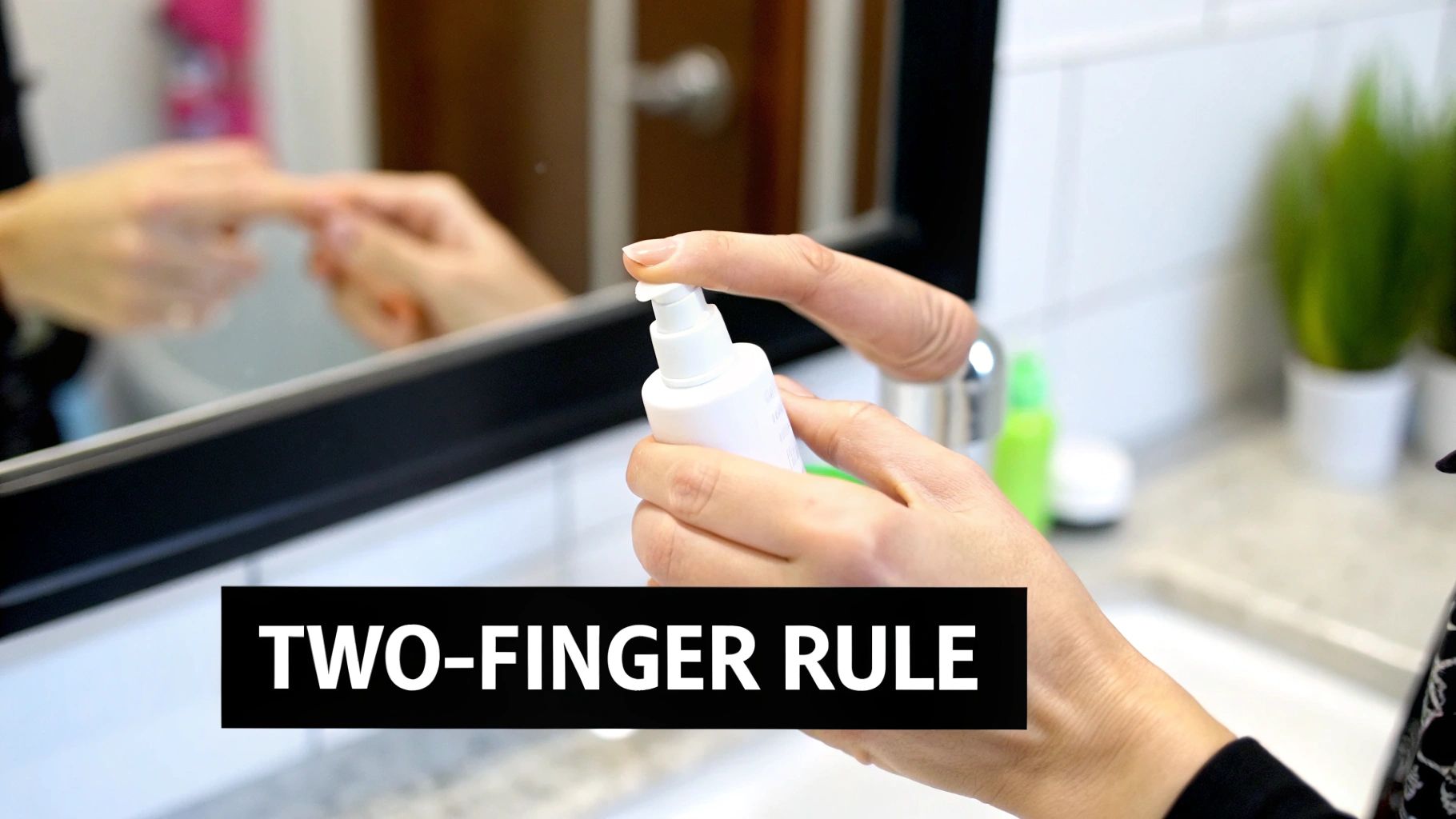
When you put it on matters, too. Slather on your SPF lotion a good 15 minutes before you step outside. This gives the sunscreen filters time to actually settle and form a protective layer on your skin. If you're curious where this fits into your whole morning ritual, check out our guide on the proper skin care order of application.
As you're applying it, don't forget the spots everyone misses. Get coverage on these high-risk areas:
That single application in the morning won't last all day. Think of it like a shield that slowly wears down. This is the habit most people—especially guys—ditch, but it’s absolutely essential.
Reapplication isn't just a suggestion; it's the key to staying protected. You're basically reloading your skin's defenses before they fail.
You need to reapply your face lotion with SPF every two hours you’re outdoors. That timeline gets even shorter if you’re swimming, sweating, or toweling off. Even sunscreens labeled "water-resistant" have their limits. For anyone spending serious time in the water, this Snorkeling UV Protection Guide has some great, specific advice on staying safe.
This isn’t just some niche advice; it's a global standard. In 2024, the Asia Pacific region made up a massive 38.68% of the entire sun care market. That tells you something about how seriously people around the world take consistent sun protection.
Even when you feel like you've got the rules down, a few questions can still pop up. The world of skincare can seem like it's full of conflicting advice, but honestly, getting the fundamentals right is simpler than you think. Let's tackle some of the most common myths and mix-ups when it comes to using a daily face lotion with SPF.
This is a big one, and the answer is an emphatic yes. Believing you're safe on an overcast day is probably the most common mistake people make, and it leaves your skin completely exposed. Even when the sky is gray, up to 80% of the sun's UV radiation slices right through the clouds and hits your skin.
Think about it this way: UVA rays—the sneaky ones responsible for premature aging like wrinkles and dark spots—are relentless. They don't take a day off, and their intensity stays pretty consistent all year long, no matter the weather. Clouds are more like a flimsy screen than a solid barrier. The damage is still getting through.
"A cloudy day is no excuse to skip your SPF. Incidental sun exposure, even on overcast days, adds up over a lifetime and is a primary driver of skin aging and cancer risk."
The only way to play it safe is to make your face lotion with SPF a non-negotiable part of your morning routine, rain or shine.
Putting all your trust in the SPF found in foundation or tinted moisturizer is a gamble. While having some SPF in your makeup is a nice little bonus, it's almost never enough to give you the protection you actually need. The real issue is how much product you apply.
To get the full SPF number printed on the label, you'd have to slather on a surprisingly thick layer—way more than anyone would ever use for a natural makeup look. Most people just apply a light, sheer coat, which means they're only getting a tiny fraction of the promised protection. That’s why you always need a dedicated face lotion with SPF underneath as your true protective base.
This is a critical distinction, especially if you lead an active life. You'll never see "waterproof" or "sweatproof" on a legitimate sunscreen anymore, and for good reason. The FDA banned those terms because they're misleading; no sunscreen on earth can last forever once you get wet or start sweating.
Instead, you’ll find the term "water-resistant," which comes with a time limit.
Once that time is up, you absolutely have to reapply. Think of these ratings as a timer telling you when to top up your protection, not a pass to forget about it for the rest of the day. And don't forget, simply drying off with a towel can wipe away your sunscreen, making reapplication a must. Your daily face lotion with SPF is perfect for a day at the office, but for the gym, a run, or a day at the beach, you need to reach for a dedicated water-resistant formula.
Ready to make daily protection a seamless part of your routine? Main Character offers skincare solutions designed to give you exactly what your skin needs without any fuss. Find the perfect product to keep your skin healthy and looking its best at https://www.dontlooktrash.com.

05.12.2025
How to Stay Focused at Work 7 Actionable Tips
04.12.2025
A Guide to Shaving with Sensitive Skin
03.12.2025
Best Grooming Products for Men A Definitive Guide
02.12.2025
How to Build Confidence for Men: Practical Guide
30.11.2025
Natural Skin Care Products Men Can Trust
29.11.2025
How to Maintain Healthy Skin A No-Nonsense Men's Guide
28.11.2025
what causes dark circles under eyes: tips and fixes